
Have you ever had to build a wall from a pile of rubble?
I certainly haven’t.
Do you feel you have the strength to do that type of work?
I would need to secure help from others to do this type of work.
How would you go about the process if you oversaw that the work was done?
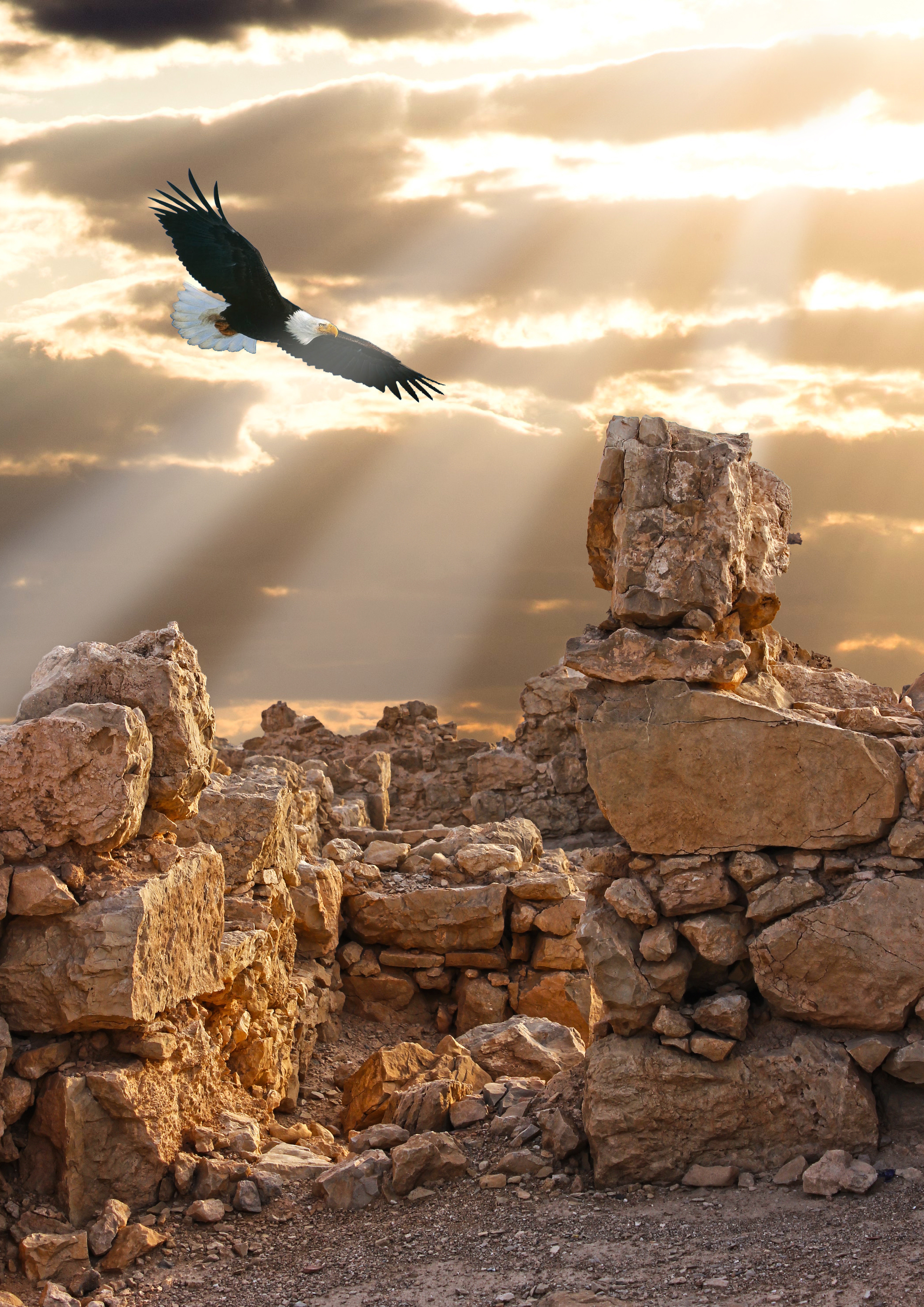
Do you find hope in the picture above or discouragement?
I see both.
The piles of stones reveal to me that someone labored to stack them, but that something has turned the structure into rubble.
I also see that to rebuild will take hard and exhausting labor, which can lead to discouragement.
But the eagle overseeing the site and the rays of sunshine signal evidence of strength and encouragement, i.e. hope for me.
What does this have to do with the study of Nehemiah 4:6-15?
The Strength Needed to Bear Our Burdens
A Study of Nehemiah 4:6-15 | The Background
Nehemiah was a cupbearer for King Artaxerxes in Susa. (Nehemiah 1:1 and 2:1)
One of his brothers arrives to report to him the condition of Jerusalem, their hometown. (Nehemiah 1:2)
Upon hearing that the wall of Jerusalem was broken down and burned with fire, Nehemiah sat down, wept, and then prayed to the Lord. (Nehemiah 1:4-11)
Nehemiah ultimately gets King Artaxerxes’ permission and provisions to return to Jerusalem to begin the daunting task of repairing the wall of Jerusalem. (Nehemiah 2:1-9)
Upon arrival in Jerusalem, Nehemiah discreetly surveyed the situation, then rallied the Jews to rebuild the wall. (Nehemiah 2:11-20)
But Nehemiah and the residents find there are those who seek to make this a burdensome process. (Nehemiah 2:10-19.)
We pick up the narrative after work on the wall has already begun.
A Study of Nehemiah 4:6-15 | The Scripture Passage
6 So we built the wall. And all the wall was joined together to half its height, for the people had a mind to work. [1]
How far have the people come in their project of rebuilding the wall by this point?
Why had they been successful in accomplishing this task thus far?
7 But when Sanballat and Tobiah and the Arabs and the Ammonites and the Ashdodites heard that the repairing of the walls of Jerusalem was going forward and that the breaches were beginning to be closed, they were very angry. 8 And they all plotted together to come and fight against Jerusalem and to cause confusion in it.[2]
Why were these people angry about the rebuilding of the wall in Jerusalem? (See Nehemiah 2:10)
How did the opposition’s tactics change compared to Nehemiah 4:1-3? Why?
9 And we prayed to our God and set a guard as a protection against them day and night. [3]
What stands out about the way Nehemiah and the residents of Jerusalem responded to this threat?
10 In Judah it was said, “The strength of those who bear the burdens is failing. There is too much rubble. By ourselves we will not be able to rebuild the wall.”[4]
What other challenges did the people of Jerusalem/Judah face?
11 And our enemies said, “They will not know or see till we come among them and kill them and stop the work.”[5]
How confident were the enemies of Jerusalem/Judah?
12 At that time the Jews who lived near them came from all directions and said to us ten times, “You must return to us.”[6]
What does the phrase “and said to us ten times” convey?
Why did the Jews who lived in proximity to these enemies want their relatives working on the walls to return to where they lived instead of continuing to build the walls?
13 So in the lowest parts of the space behind the wall, in open places, I stationed the people by their clans, with their swords, their spears, and their bows. 14 And I looked and arose and said to the nobles and to the officials and to the rest of the people, “Do not be afraid of them. Remember the Lord, who is great and awesome, and fight for your brothers, your sons, your daughters, your wives, and your homes.”[7]
What action did Nehemiah take in response to the people’s concerns?
Why did he target the lowest parts behind the wall and open places?
Why was it important for Nehemiah to say, “Remember the Lord, who is great and awesome” to the people of Jerusalem/Judah?
15 When our enemies heard that it was known to us and that God had frustrated their plan, we all returned to the wall, each to his work.[8]
Who provided the strength needed for Nehemiah and the residents of Jerusalem/Judah to succeed in their work against vehement opposition?
The Strength Needed to Bear Our Burdens
A Study of Nehemiah 4:6-15 | Application for Today
Describe a time you faced a significant challenge in your life.
How did you overcome or how are you overcoming this challenge?
Is there anything you would or need to do differently based on this passage of Nehemiah?
What helps you to “Remember the Lord, who is great and awesome?”
Describe the calling the Lord has for you.
List those who are helping you stay the course for this calling from the Lord.
Remember to thank the Lord for those coworkers or family members who support and encourage you. Also, remember to thank them, too.
The Strength Needed to Bear Our Burdens
A Study of Nehemiah 4:6-15 | A Prayer
Heavenly Father, thank you for providing this encouragement that you are the strength we need to bear our burdens in this life. Help us remember how great and awesome you are. Show us how you provide for us each day of our lives.
Grant us the mind to heed the calling you have prepared in advance for us to do for your glory on this earth.
Thank you also for this reminder that we also have a responsibility to be on guard against the attack of those who are against you and your people. Fill us with the readiness to be diligent in our work while also being ready to protect our coworkers and families from harm.
We praise you, most holy God. Amen.
An Affirmation from the Lord.
10 fear not, for I am with you;
be not dismayed, for I am your God;
I will strengthen you, I will help you,
I will uphold you with my righteous right hand.
11 Behold, all who are incensed against you
shall be put to shame and confounded;
those who strive against you
shall be as nothing and shall perish.
12 You shall seek those who contend with you,
but you shall not find them;
those who war against you
shall be as nothing at all.
13 For I, the Lord your God,
hold your right hand;
it is I who say to you, “Fear not,
I am the one who helps you.” [9]
Share in the comments how this study encouraged you.
Warmly,
Barbara Lynn
[1] The Holy Bible: English Standard Version (Wheaton, IL: Crossway Bibles, 2025), Ne 4:6.
[2] The Holy Bible: English Standard Version (Wheaton, IL: Crossway Bibles, 2025), Ne 4:7–8.
[3] The Holy Bible: English Standard Version (Wheaton, IL: Crossway Bibles, 2025), Ne 4:9.
[4] The Holy Bible: English Standard Version (Wheaton, IL: Crossway Bibles, 2025), Ne 4:10.
[5] The Holy Bible: English Standard Version (Wheaton, IL: Crossway Bibles, 2025), Ne 4:11.
[6] The Holy Bible: English Standard Version (Wheaton, IL: Crossway Bibles, 2025), Ne 4:12.
[7] The Holy Bible: English Standard Version (Wheaton, IL: Crossway Bibles, 2025), Ne 4:13–14.
[8] The Holy Bible: English Standard Version (Wheaton, IL: Crossway Bibles, 2025), Ne 4:15.
[9] The Holy Bible: English Standard Version (Wheaton, IL: Crossway Bibles, 2025), Is 41:10–13.